
Project ALBEDO
By 2029, the climate crisis was no longer a prediction. The people of planet Earth were desperate. A new organization was founded: the Earth Interstellar Climate Agency (EICA). One of its first projects was called ALBEDO — the building and sending of a bipedal field research unit to Kepler-452b, to learn from the climate effects of a world further along the same path, and bring that knowledge back to help save Earth.
Kepler-452b is 1,400 light-years away. At the speeds humanity can reach, the journey takes over a thousand years. ALBEDO was launched in 2031. It should not have returned for centuries — if ever.
It was recovered in 2024… before it was launched…

Built for a world with 1.9G surface gravity, every centimeter of unnecessary height was a liability. The torso measures 35 cm across and 12 cm deep, and the unit rests on a circular base 26 cm in diameter — a wide, stable footprint designed for uneven volcanic terrain under nearly twice Earth's gravitational pull. Its form is deliberately anthropomorphic — two arms, two legs, an upright torso — a design choice made by EICA engineers not for aesthetics but for function. A bipedal frame with articulated arms can operate the same tools, access the same terrain, and fit through the same spaces as the humans who built it. Familiarity of form was considered an engineering asset.
The unit shows significant wear consistent with prolonged operation in a hostile environment. This is not damage. It is a record.
Physical dimensions — as recovered:
Height: 78 cm / 30.7 in
Width (torso): 35 cm / 13.8 in
Depth (torso): 12 cm / 4.7 in
Base diameter: 26 cm / 10.2 in
Weight:10 kg / 22 lb
Price: 2499 EUR
Mission Overview
| Field | Detail |
|---|---|
| Unit designation | KOI-7016/CR-9 "ALBEDO" |
| Built by | Earth Interstellar Climate Agency (EICA) |
| Launch year | 2031 CE |
| Launch corridor | Cygnus |
| Destination | Kepler-452b — target arrival window ~3200–3400 CE |
| Mission objective | Observe climate intervention on an analog world, collect atmospheric and geological samples, return data to Earth before the point of no return |
| Mission duration | ~1,200 years in transit — recovered 2024 CE |
| Recovery date | 2024 CE — ahead of its own launch date Temporal anomaly |
| Recovery location | Earth upper atmosphere — untracked re-entry trajectory |
| Hull material | Iron-silicate alloy with iridium trace — deposited on Kepler-452b |
| Power status | Residual charge in core cell — unexplained Active |
| Memory core | Partially intact Extraction ongoing |
ALBEDO — the measure of how much light a surface reflects. A planet losing its ice loses its albedo, accelerating warming.
The name was chosen deliberately. Earth in 2029 was already watching its own albedo decline — Arctic ice retreating, cloud cover shifting, the planet absorbing more of what its star sent. The unit was named not for what it is, but for what it was sent to understand: whether a world caught in that spiral can find its way back. The question ALBEDO went to answer is the same question Earth is now living.

The crisis that sent it
By the late 2020s, the scientific community from Earth had exhausted conventional timelines to solve the climate crisis. The interventions that were politically achievable were not sufficient. The breakthrough came from an unexpected direction: not from looking at what Earth could do, but from looking at what another world had already done.
Kepler-452b had been warming for longer than human civilization had existed. Its star — a G2 like our Sun but 1.5 billion years older — had been slowly brightening for eons, pushing more radiation onto the planet's surface year by year.
The planet had been living Earth's climate future in slow motion for a billion years. If anything had survived there — any civilization, any ecosystem, any engineered response to a warming world — it had done so against odds that made Earth's crisis look early. EICA was built on a single proposition: go there, see what worked, and bring it back.

Design & Engineering
ALBEDO was built for a world it had never been to. The engineering team worked from telescope data, atmospheric models, and gravitational estimates. The hull is iron-silicate alloy — dense, low to the ground, built for 1.9G and volcanic terrain. The sensor arrays were designed to survive a CO₂-rich, sulfur-laden atmosphere. The sample storage chambers are sealed against contamination that would take centuries to reach them.
The surface oxidation visible on the unit today is not decay. It is the chemical record of Kepler-452b's atmosphere — acid particulate, volcanic sulfur, the fingerprint of a world under pressure. The iridium trace in the outer plating was not in the original specification. Recovery teams believe it was deposited during surface operations — absorbed from the mineral-rich environment of a planet whose star had seeded the system with heavy metals for six billion years. ALBEDO came back carrying pieces of another world embedded in its skin.
Frame — bipedal, anthropomorphic, iron-silicate alloy hull; 78 cm tall, 35 cm wide, 12 cm deep; dense and low-set for 1.9G surface stability
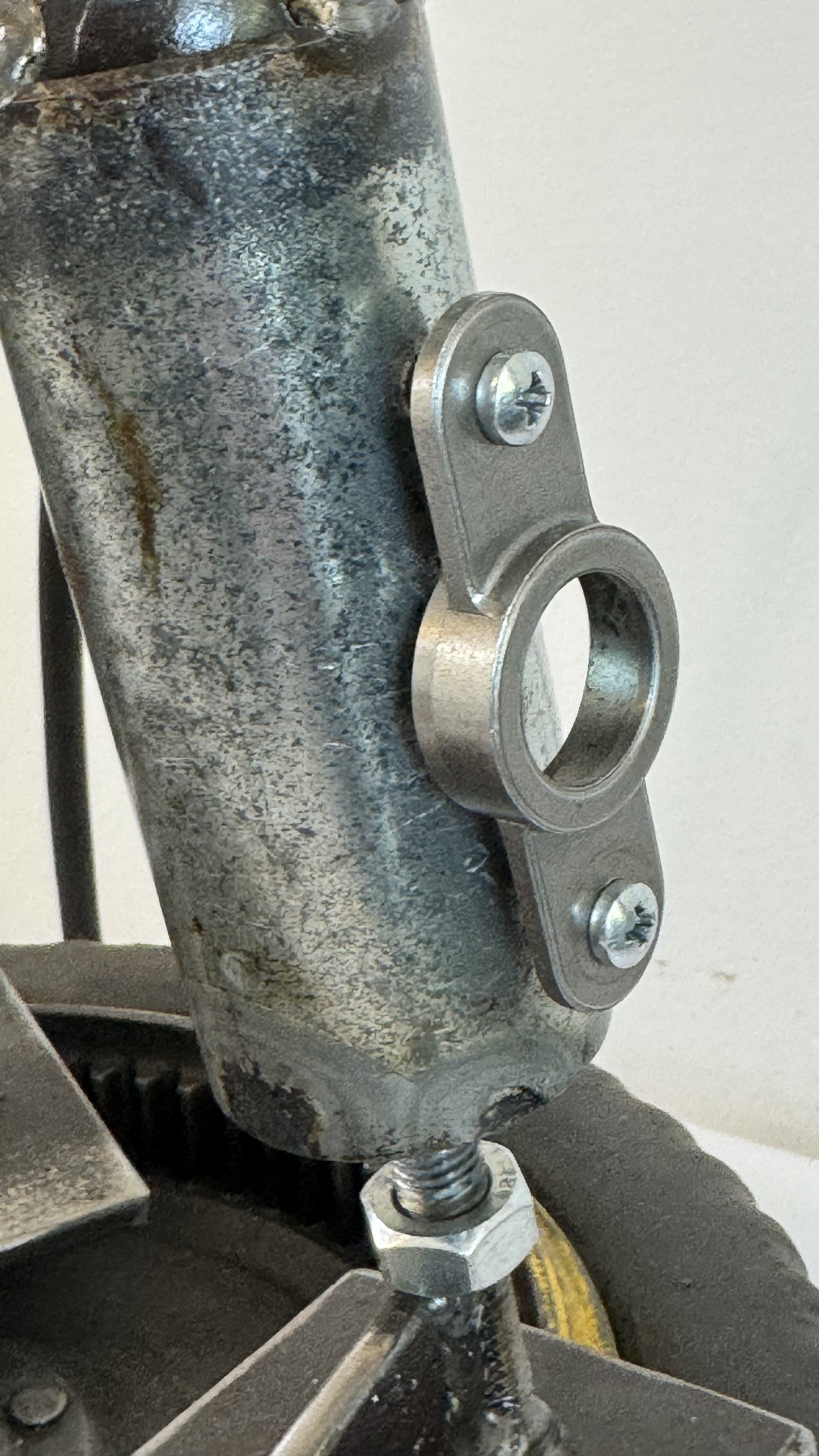
Base — circular mounting platform, 26 cm diameter; wide-stance for volcanic terrain stability
Legs — two, wide-stance, reinforced at knee and hip joints; gait system non-functional on recovery
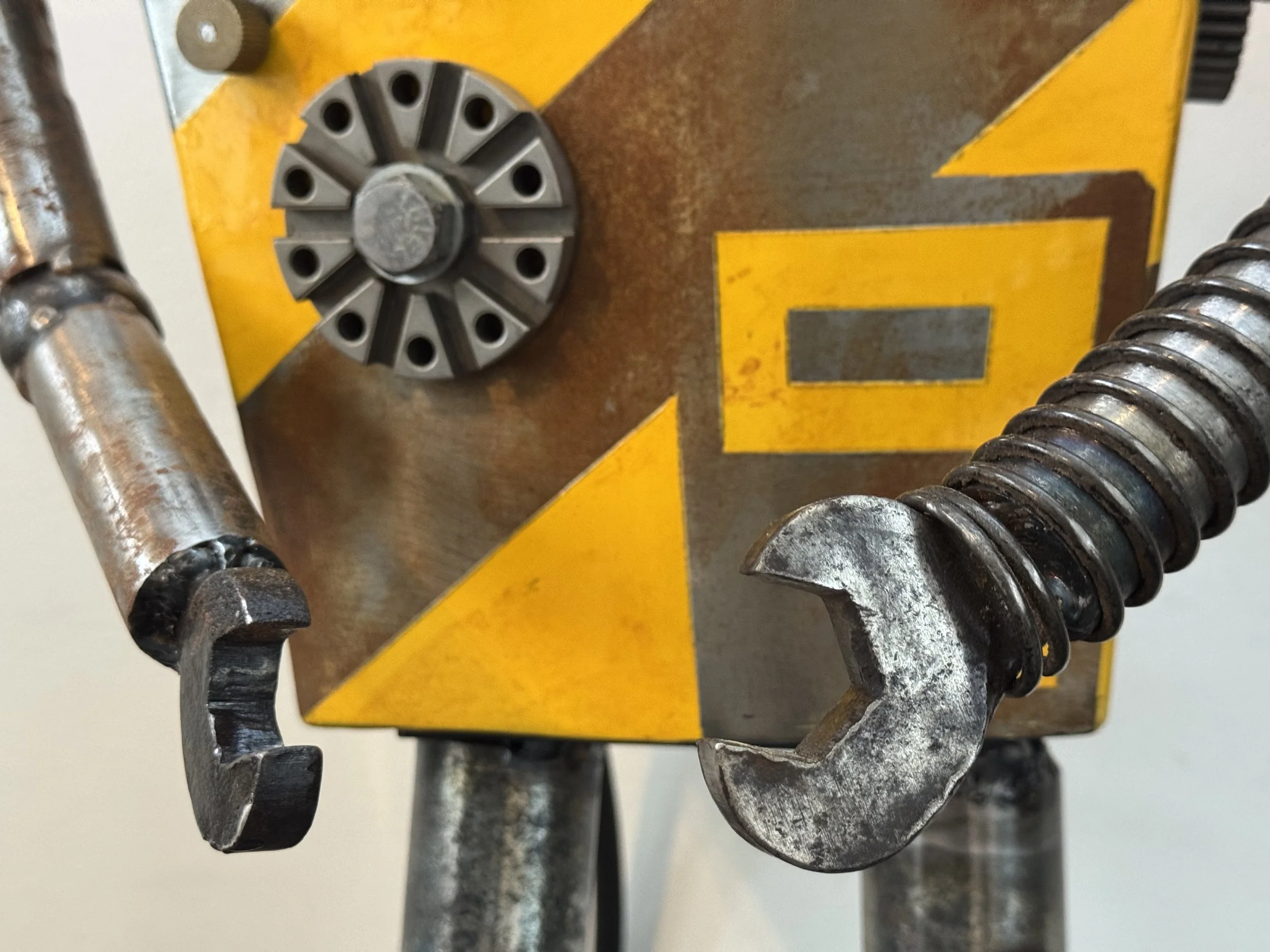
Arms — two, fully articulated, open-frame construction for field inspection without disassembly
Hands — wrench-form manipulator end-effectors; dual-purpose for geological sampling and self-repair; every bolt on the unit sized to the span of its own hands
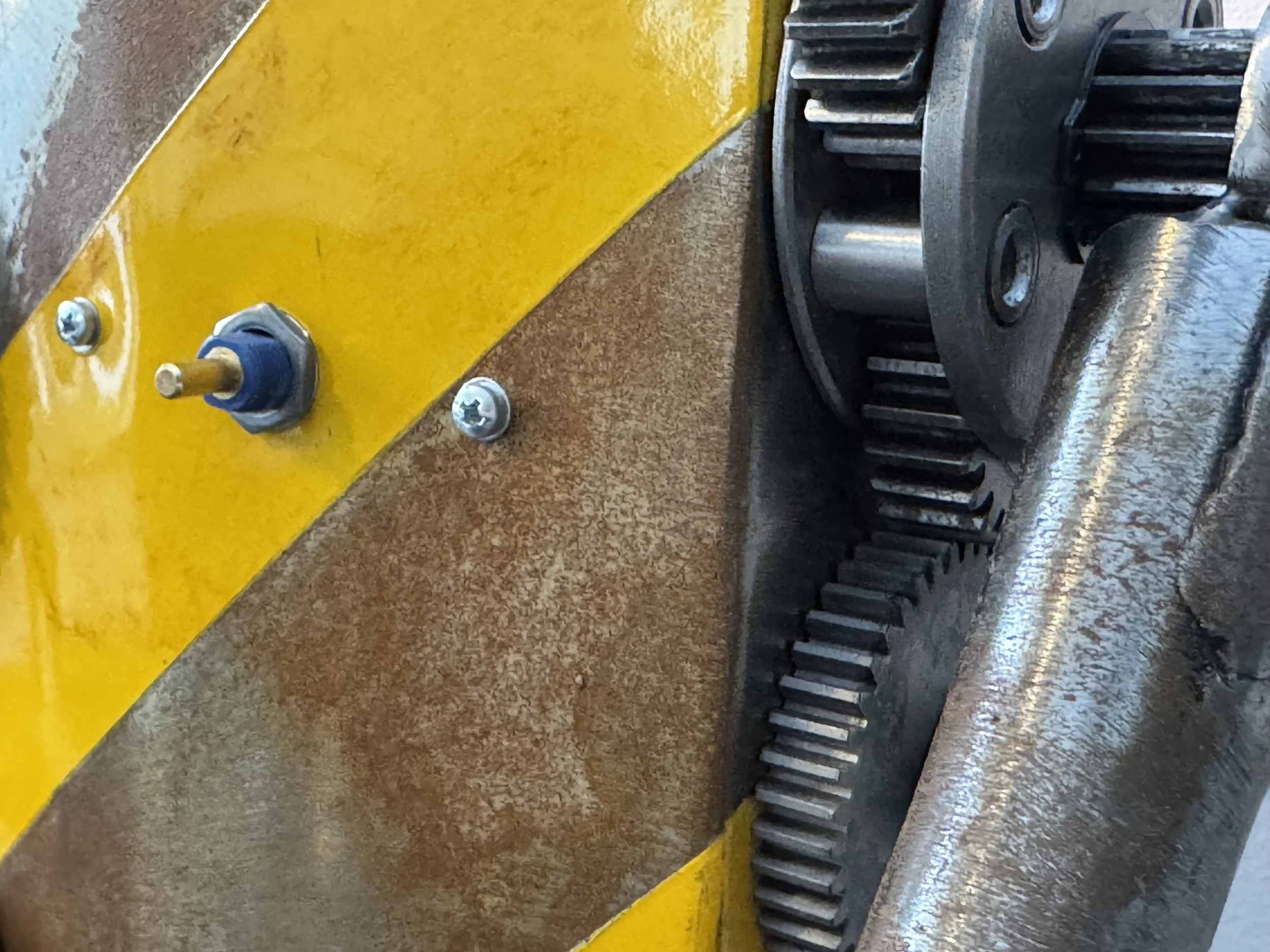
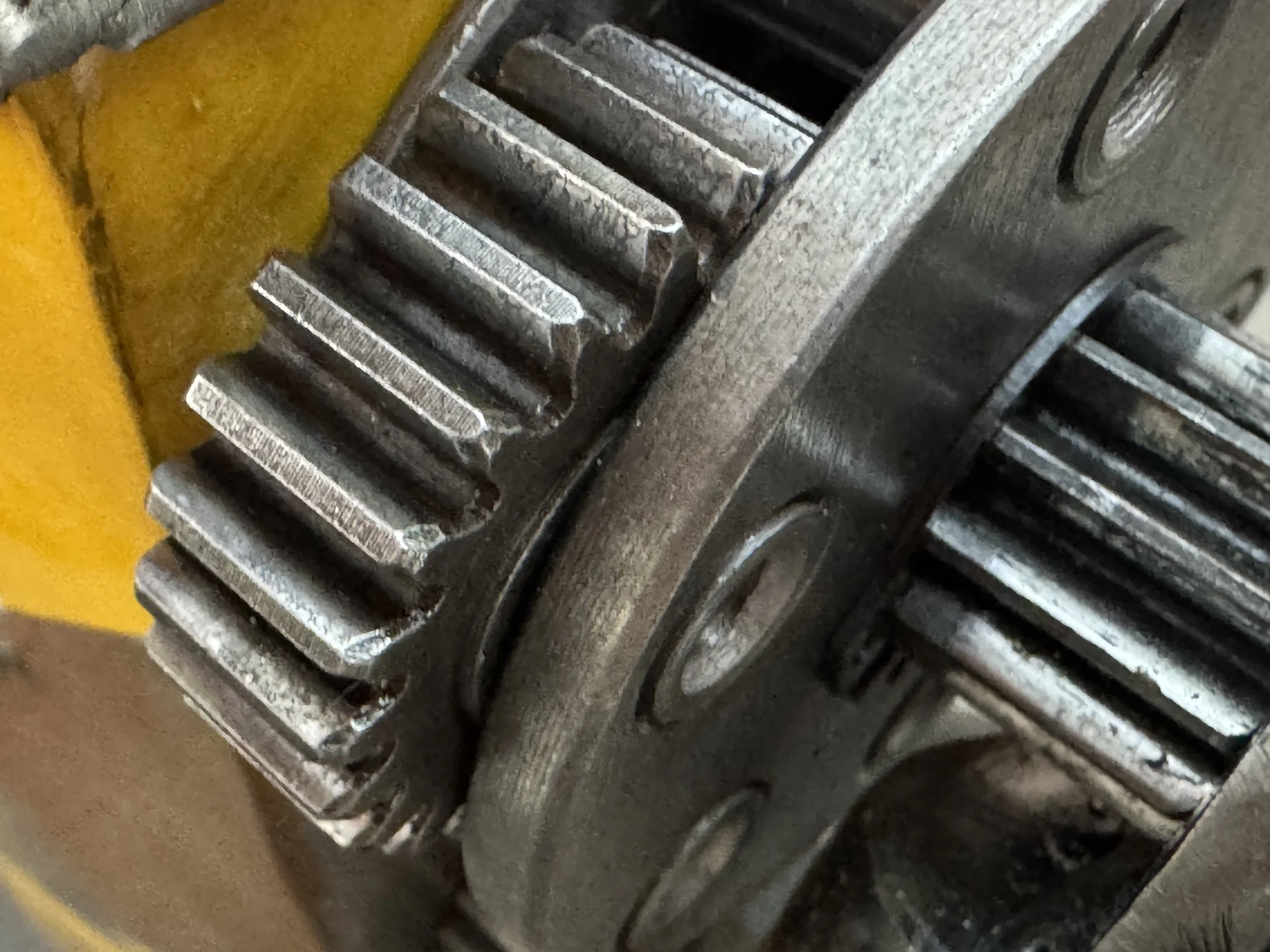
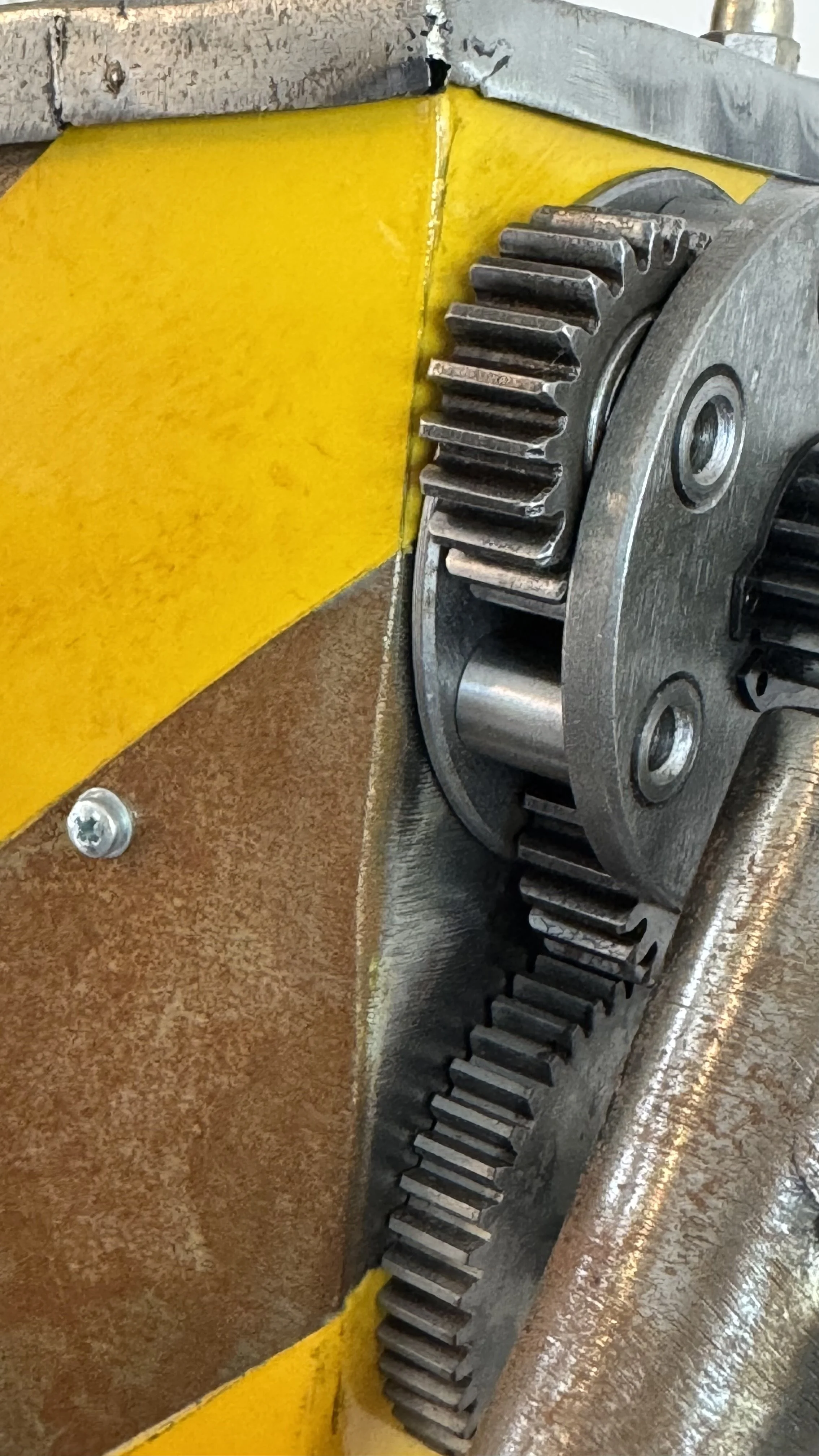
Gears — exposed throughout the frame by design; torque management at all major joints; micro-etched by Kepler-452b mineral particulate — confirmed extraterrestrial in origin
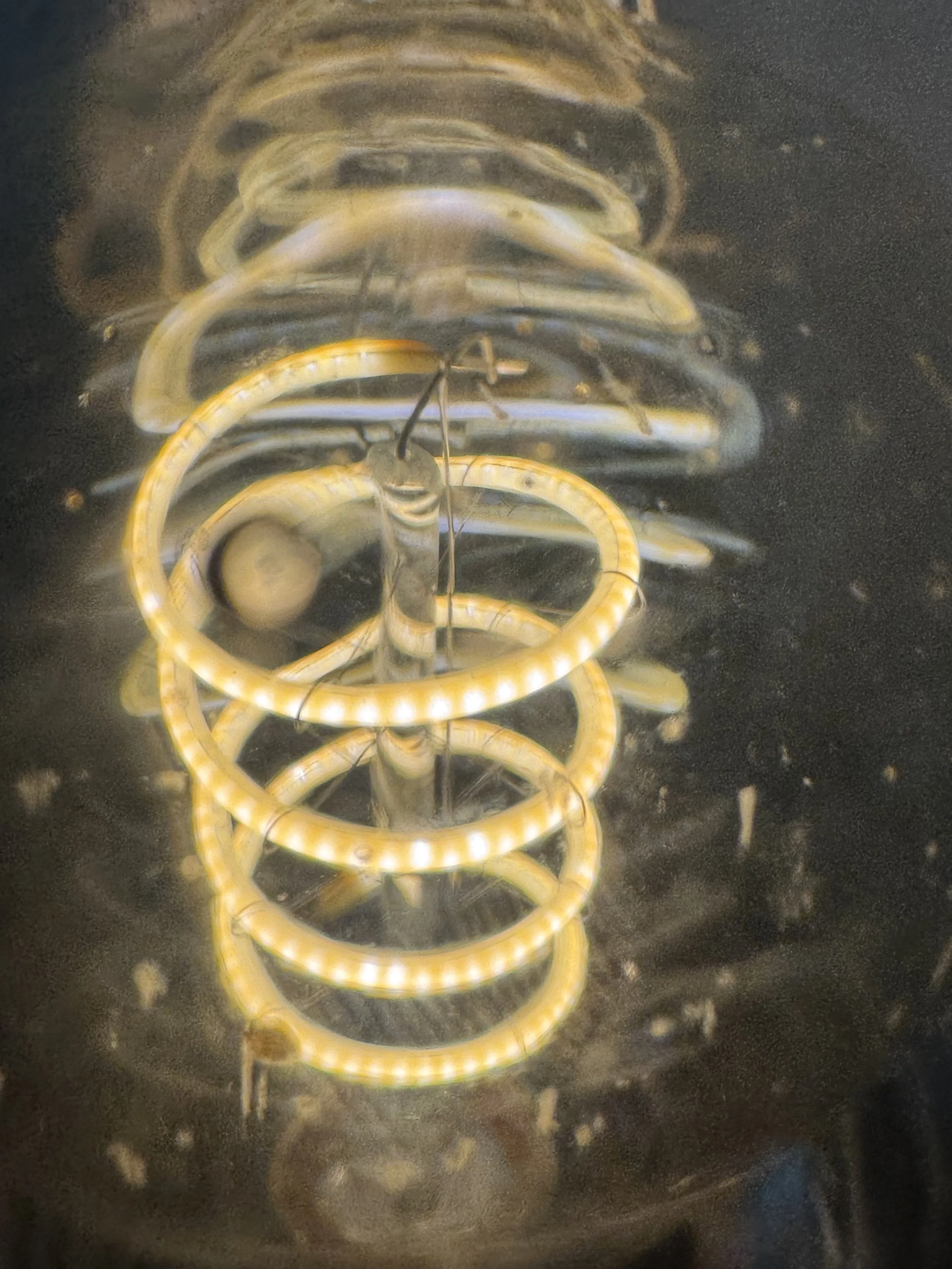
Head — houses primary optical and atmospheric sensor array; built around a broad-spectrum variable light emitter
Light — dimmable; designed for photosensitive measurement precision as well as illumination; partially functional on recovery; amber-shifted from iridium oxide lens deposits; dimming function still active — trigger unknown. The unit operates on 230V mains power. The head lamp fitting accepts a standard E27 bulb. An internal specialized LED dimmer allows full brightness control and supports low-wattage LED lamps without flicker or cutoff
Marking — white 9 hand-painted on torso by ground crew before launch; the only marking not machine-stamped; slightly scorched, still legible
Serial Number KOI-7016/CR-9
KOI  -  7016  /  CR  -  9
 |      |        |       |
 |      |        |       └── Unit number within the CR series
 |      |        |           Field-marked in paint by ground crew at launch
 |      |        |           indicating the 9th climate research unit built
 |      |        |
 |      |        └── CR — Climate Research
 |      |               Mission class designation assigned by EICA
 |      |               All Kepler-452b survey units carry this prefix
 |      |
 |      └── 7016 — Kepler Object of Interest catalog number
 |                  Original designation from the Kepler space telescope
 |                  (NASA, 2015) for the Kepler-452 star system
 |                  Carried forward into mission naming as a direct
 |                  reference to the planet's discovery
 |
 └── KOI — Kepler Object of Interest
            Astronomical classification from the original Kepler
            telescope mission — retained as a deliberate historical
            anchor, a reminder that the EICA program began with a
            single pixel of light observed from Earth in 2015


Planet Summary — Kepler-452b
| Field | Detail |
|---|---|
| Unit designation | KOI-7016/CR-9 "ALBEDO" |
| Built by | Earth Interstellar Climate Agency (EICA) |
| Launch year | 2031 CE |
| Launch corridor | Cygnus |
| Destination | Kepler-452b — target arrival window ~3200–3400 CE |
| Mission objective | Observe climate intervention on an analog world, collect atmospheric and geological samples, return data to Earth before the point of no return |
| Mission duration | ~1,200 years in transit — recovered 2024 CE |
| Recovery date | 2024 CE — ahead of its own launch date Temporal anomaly |
| Recovery location | Earth upper atmosphere — untracked re-entry trajectory |
| Hull material | Iron-silicate alloy with iridium trace — deposited on Kepler-452b |
| Power status | Residual charge in core cell — unexplained Active |
| Memory core | Partially intact Extraction ongoing |

What it brought back
The memory core is damaged but not lost. What has been recovered so far includes atmospheric composition data spanning several centuries of Kepler-452b's timeline, geological survey records of volcanic basalt formations and their carbon uptake rates, and observational data on what appears to be a large-scale albedo management system — reflective particulate distributed at altitude, maintaining surface temperature within survivable range despite a star twenty percent brighter than our own.
The data is not a complete answer. It is a direction. Earth's scientists now have something they did not have before ALBEDO returned: evidence that a world further along this path found interventions that worked — at scale, across centuries. The details are still being translated. The implications are still being understood.
The power cell registers a faint residual charge. It has been active since recovery. No explanation has been found for why it has not discharged. Whether it is a malfunction, a design feature, or something the unit absorbed on Kepler-452b alongside the samples — no one has yet been able to say.